Clinic Pay Tracker
A pay-tracking and invoicing tool for a self-employed dental specialist working across two clinics with two different pay structures.
My wife is self-employed across two dental clinics that pay her in completely different ways — one on an hourly rate plus a two-tier treatment commission and a set of flat daily bonuses, the other on a per-treatment rate table with no hourly component at all. She was tracking both by memory and a notes app, then reconstructing the month from scratch to invoice each clinic — easy to under-bill, easy to lose a day entirely.
She needed something she could log on her phone in under a minute after each shift, that would do the maths itself for whichever clinic she'd worked that day, and hand her a ready-to-send invoice at the end of the month.
My wife — a self-employed dental specialist working across two clinics (a London practice and one in Southend-on-Sea) with different pay structures at each. She's the only user, logging her own pay on her phone after each shift.
Solo engineering team, alongside a full-time role at TCS — built and maintain the whole thing: the frontend, the Worker API, and the D1 schema.
It's deliberately the simplest stack that could do the job. index.html is the entire frontend — no framework, no build step — hosted on GitHub Pages behind a custom domain. It talks to a small Cloudflare Worker API backed by Cloudflare D1.
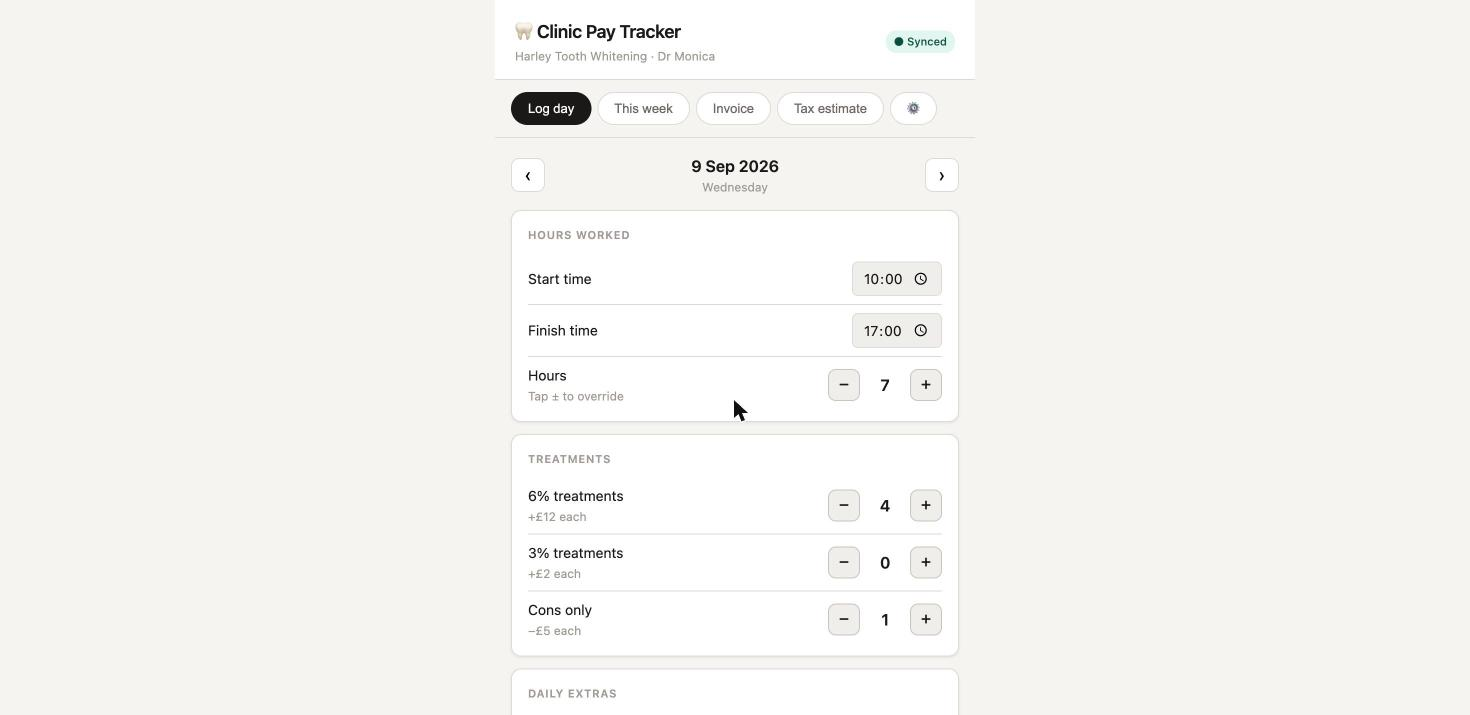
Two clinics, two pay formulas, one app. Each clinic has its own calculation function. The Harley clinic is hourly + tiered treatment commission + flat daily bonuses (see the snippet below); the Southend clinic is an entirely different item-and-rate-table model. Switching clinics in the UI swaps which formula and which invoice renderer is used — there's no attempt to unify them into one generic model, because they aren't actually the same shape of problem.
One table in a shared database. The D1 database (los-db) is shared with another one of my projects — the Worker only ever reads or writes the single clinic_days table that belongs to this app, identified by a YYYY-MM-DD key per day worked.
Auth is a shared password, on purpose. There's exactly one real user, so a single app-wide password gating both the frontend and the Worker API is enough — no accounts, no sessions, no OAuth. It's the right amount of engineering for who actually uses this.
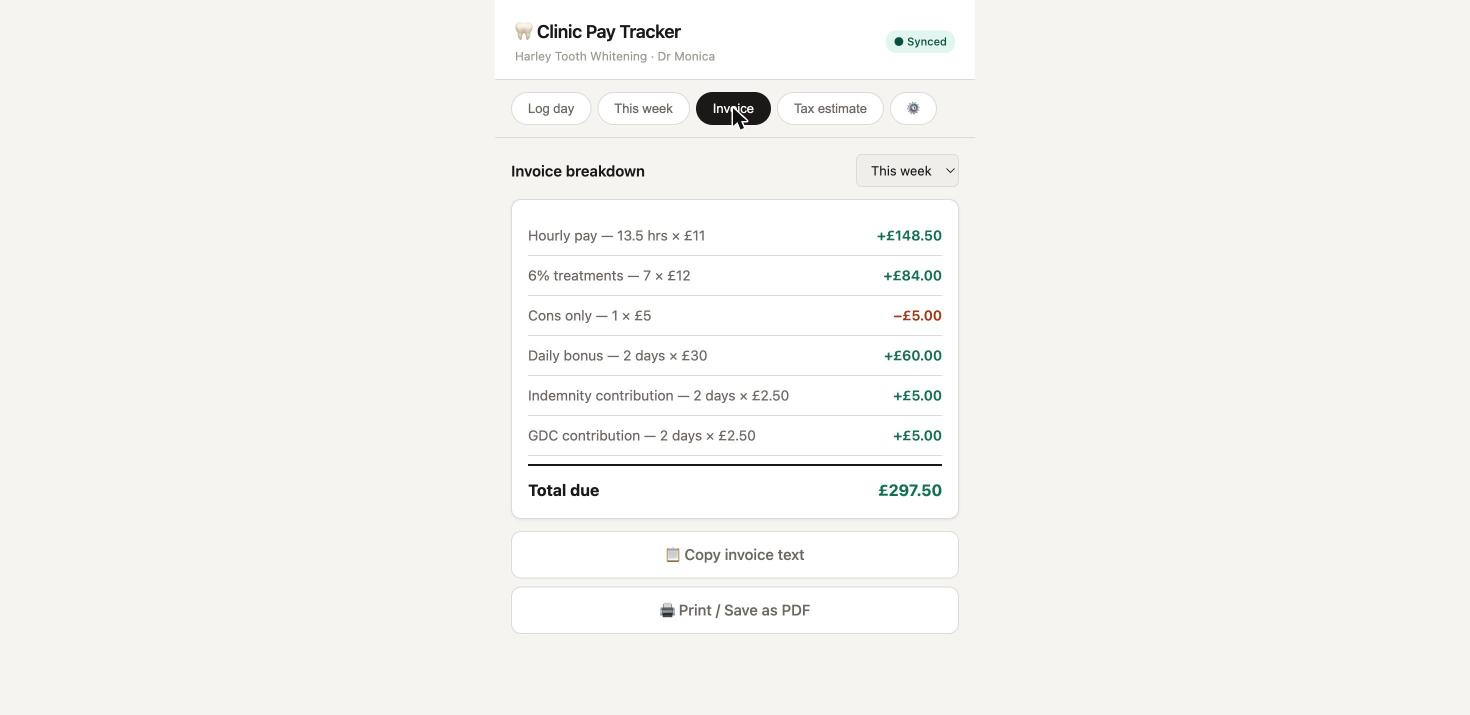
Invoicing is a copy-paste, not a PDF. At month end, the invoice tab totals up hours and treatments for the period and renders a plain-text summary she copies straight into a message to the clinic — matching how she actually sends invoices today rather than generating a document nobody asked for.
function calcDay(s) {
  const hourly = s.hours * 11;
  const treats = (s.t6*12)+(s.t3*2)-(s.cons*5);
  const extras = (s.bonus?30:0)+(s.indem?2.5:0)+(s.gdc?2.5:0);
  return { hourly, treats, extras, total: hourly+treats+extras };
}
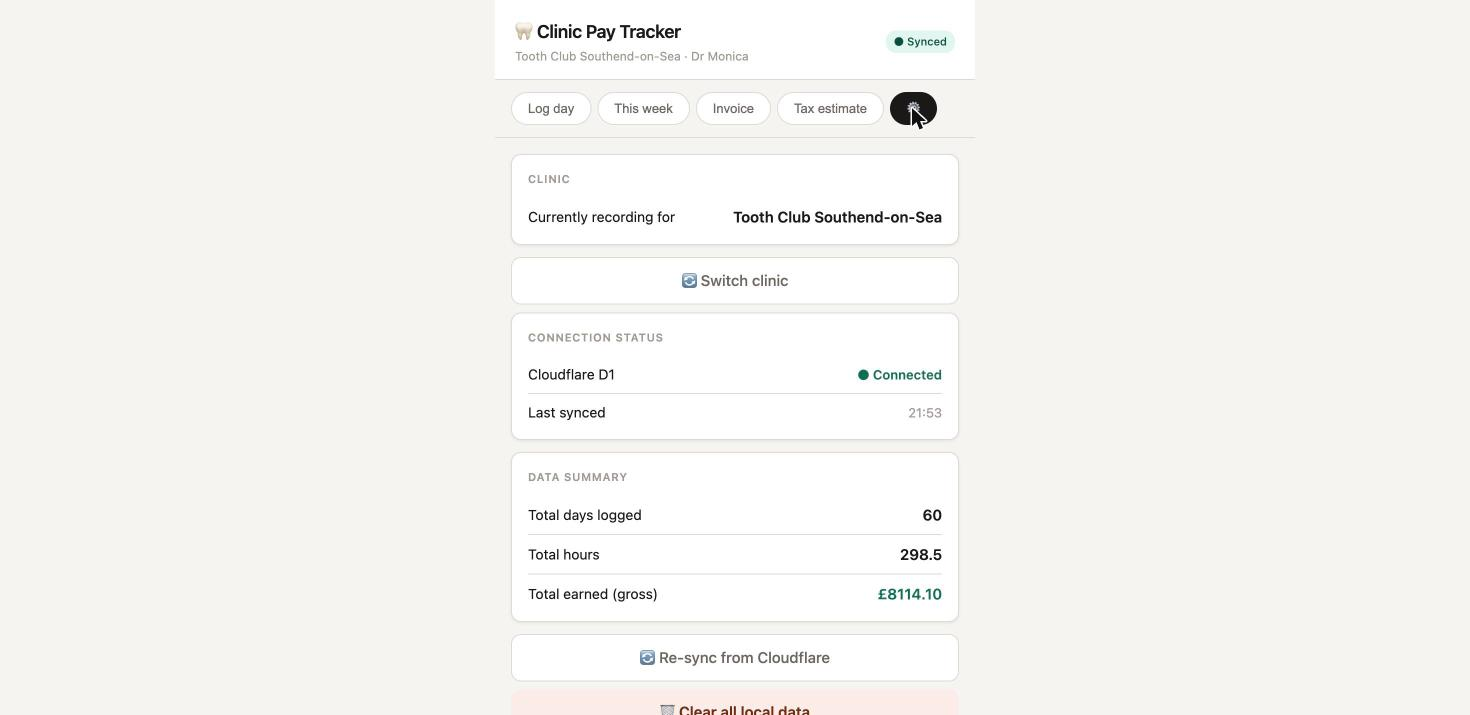
In daily use since it was built: 60 days logged, 298.5 hours, £8,114.10 tracked in gross fees — real numbers pulled straight from the app's own data summary, not an estimate. Logging a shift now takes under a minute on her phone, and month-end invoicing is copy-paste instead of reconstructing the month from memory.
It's the smallest of these projects by far, and it hasn't needed to change since — which, for a tool that has to survive being used by someone other than the person who built it, is the actual measure of whether it works.